

In This Article Show
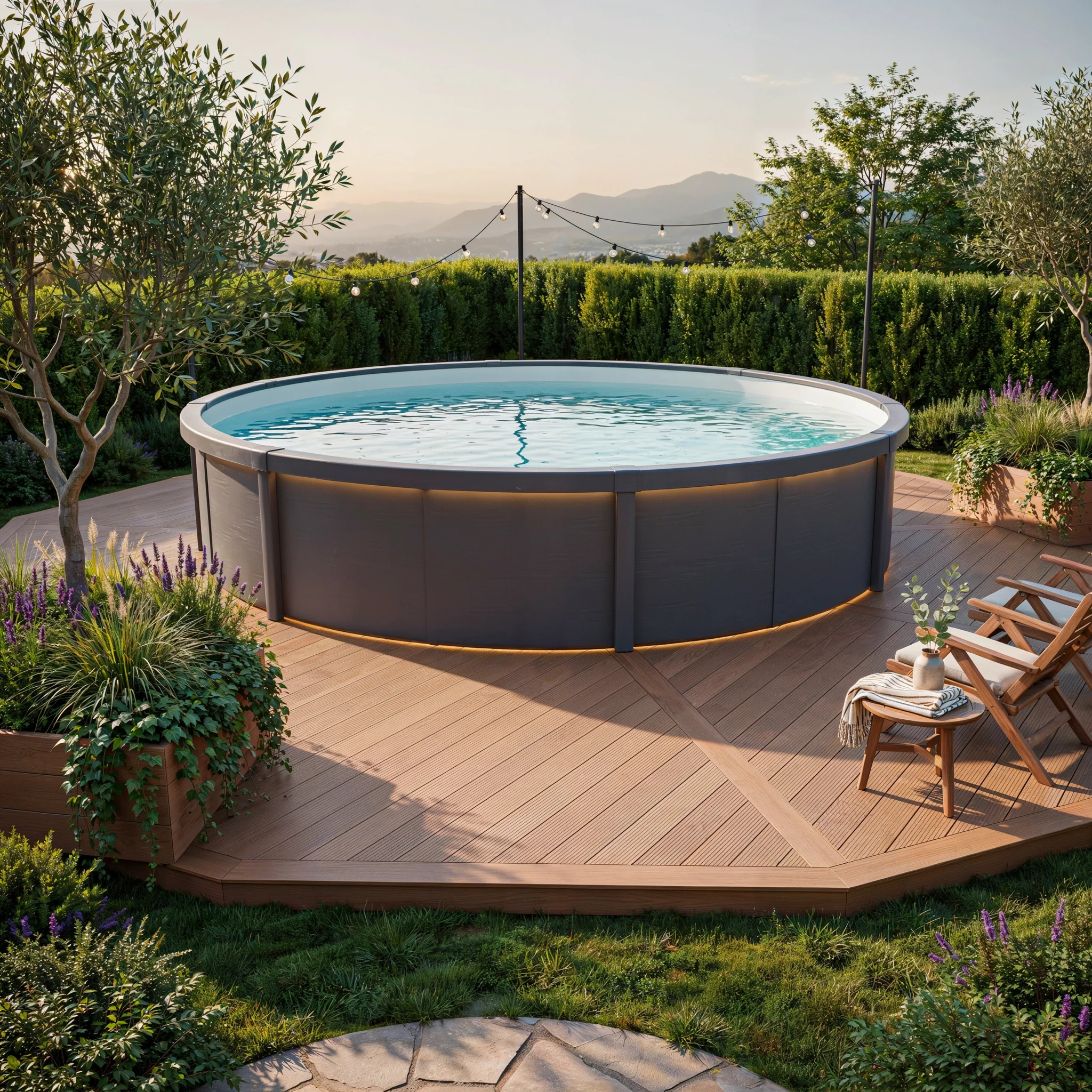
When we put in our above ground pool, I worried it would look cheap sitting in the yard. A few weekends of decking, planting, and small upgrades changed that completely.
These stunning above ground pool ideas on a budget show how to dress up your pool without draining your savings. I have added three easy projects, product picks, and safety notes for decks, pallets, and pool barriers.
1. Partial Modular Deck
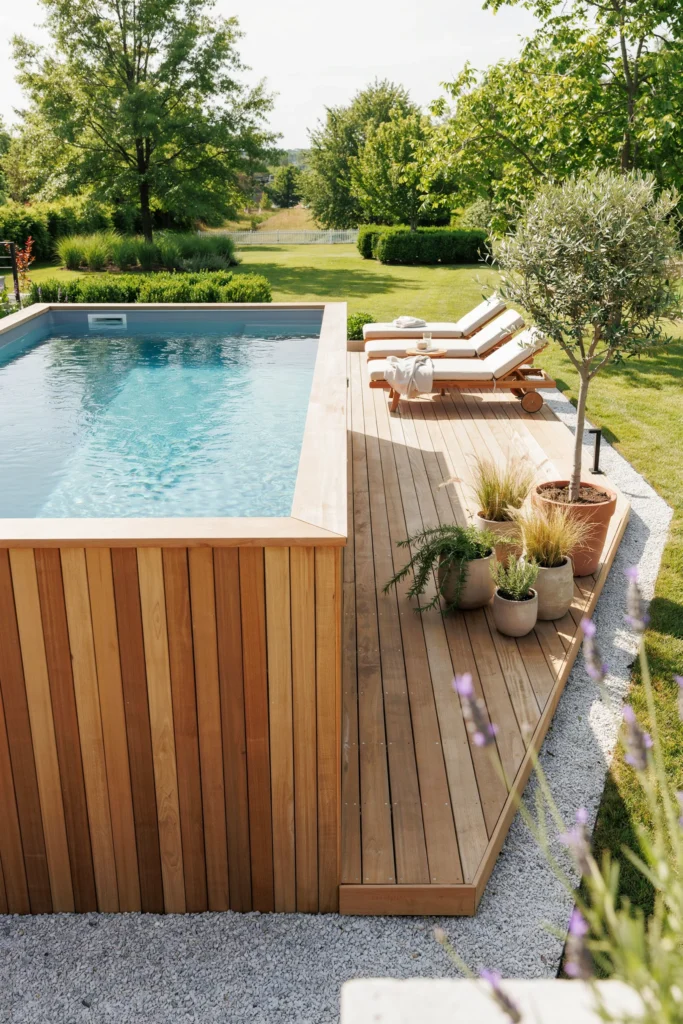
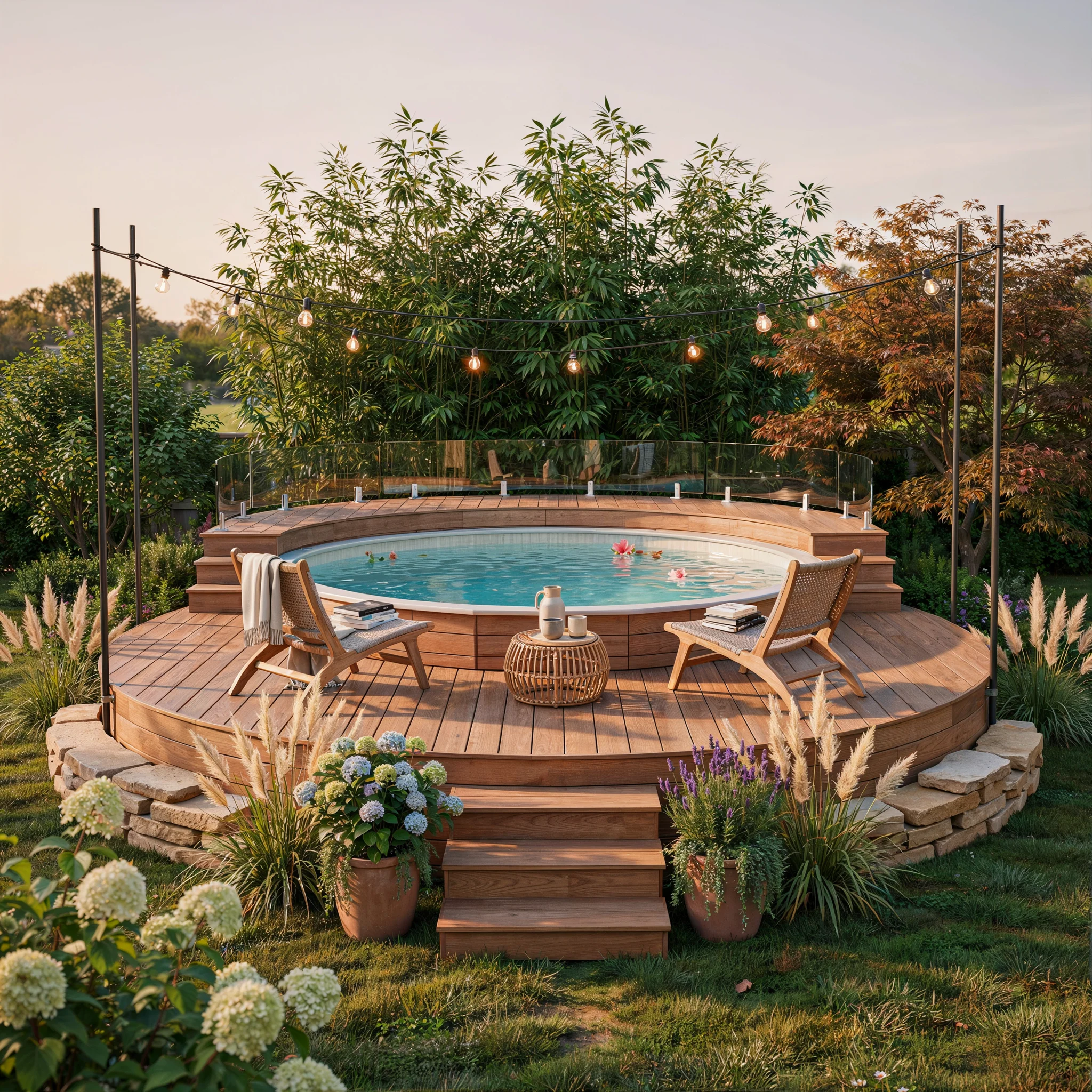
You do not need a full wraparound deck to make your pool feel built in. A partial deck by the entry gives you a clean place to step in and out.
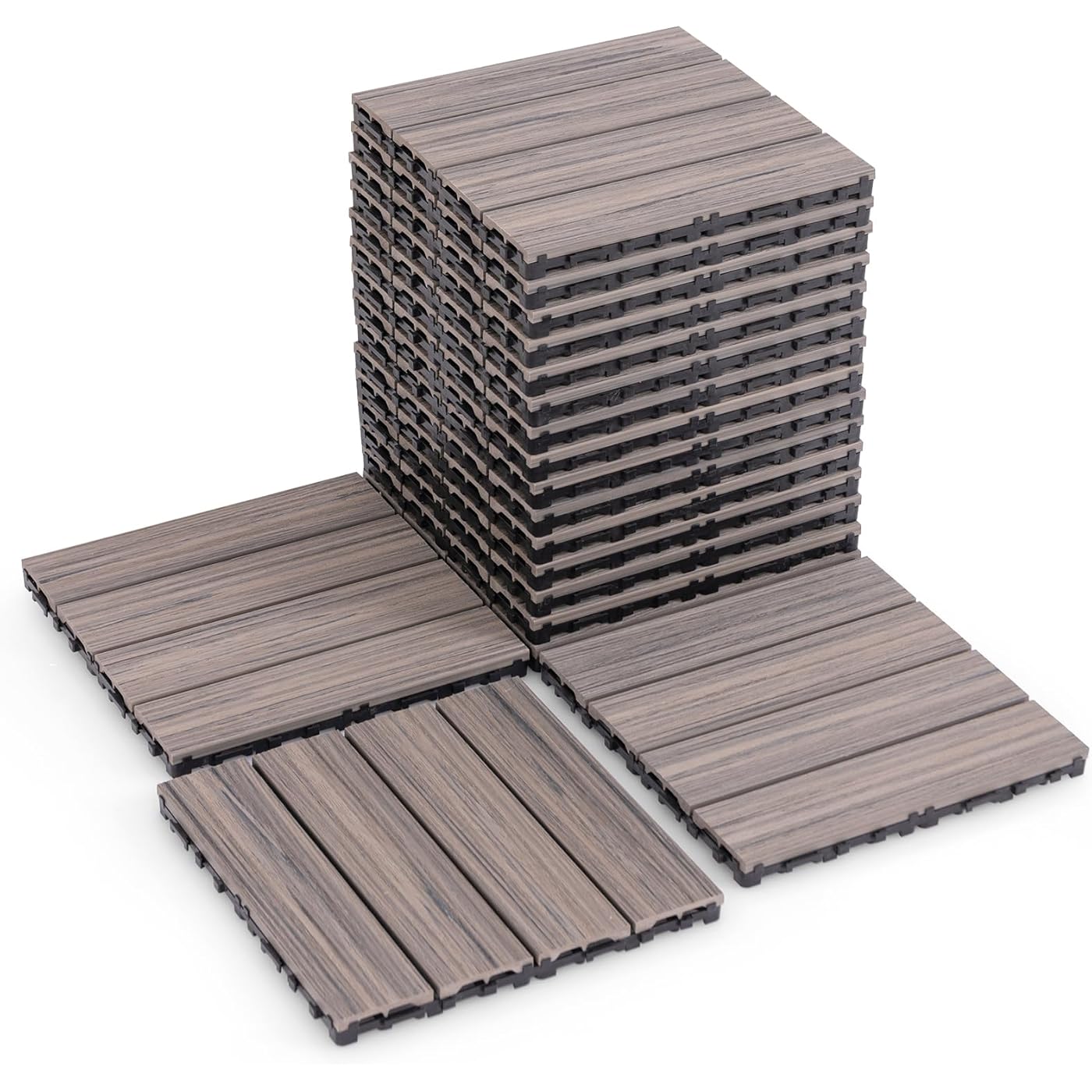
Modular deck tiles cut the material cost and still look intentional. Add a small bench at the edge for towels and drinks.
Quick checklist: For more deck shapes, see these above ground pool deck ideas.
- Start with the entry side, where foot traffic is heaviest
- Use pressure treated lumber or composite tiles for longevity
- Add a small bench at the deck edge for towels and drinks
- Lower cost
- Clean entry
- Weekend build
2. Pallet Launch Deck
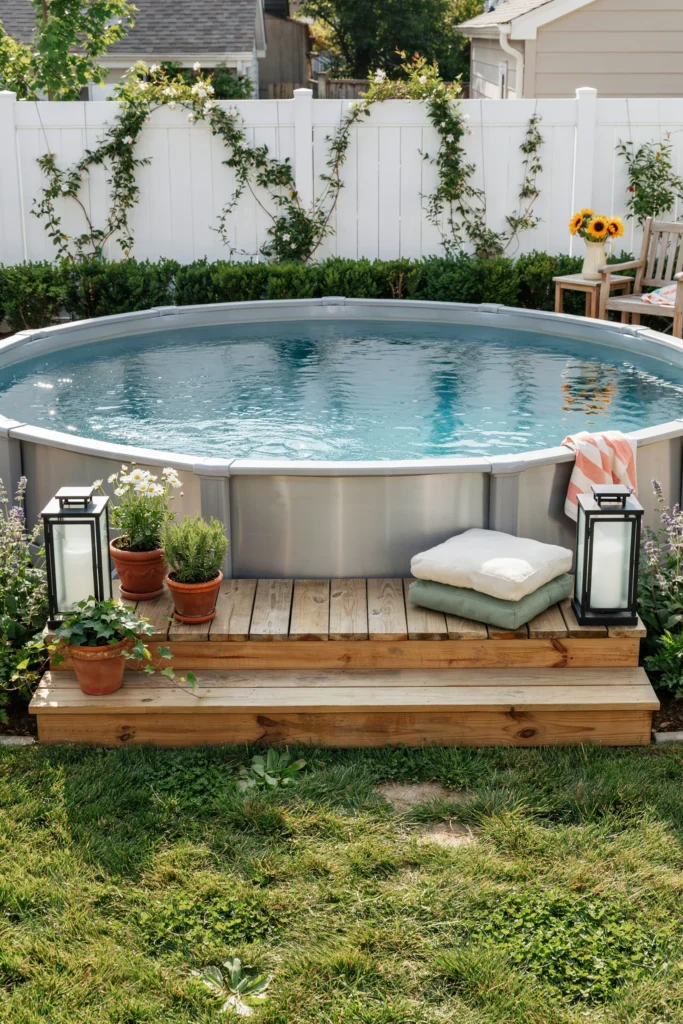
Reclaimed pallets make a cheap launch platform. Sand them, seal them, and stack two layers for height.
Only use pallets stamped HT for heat treated, never chemically treated ones. Pallets wear out faster than lumber, so check for loose boards each season.
Quick checklist:
- Choose heat treated pallets (stamped HT), never chemically treated ones
- Seal with outdoor rated stain to prevent splintering
- Pair with an outdoor rug to soften the look
- Budget build
- HT stamp only
- Check each season
3. Timber Sleeper Edging
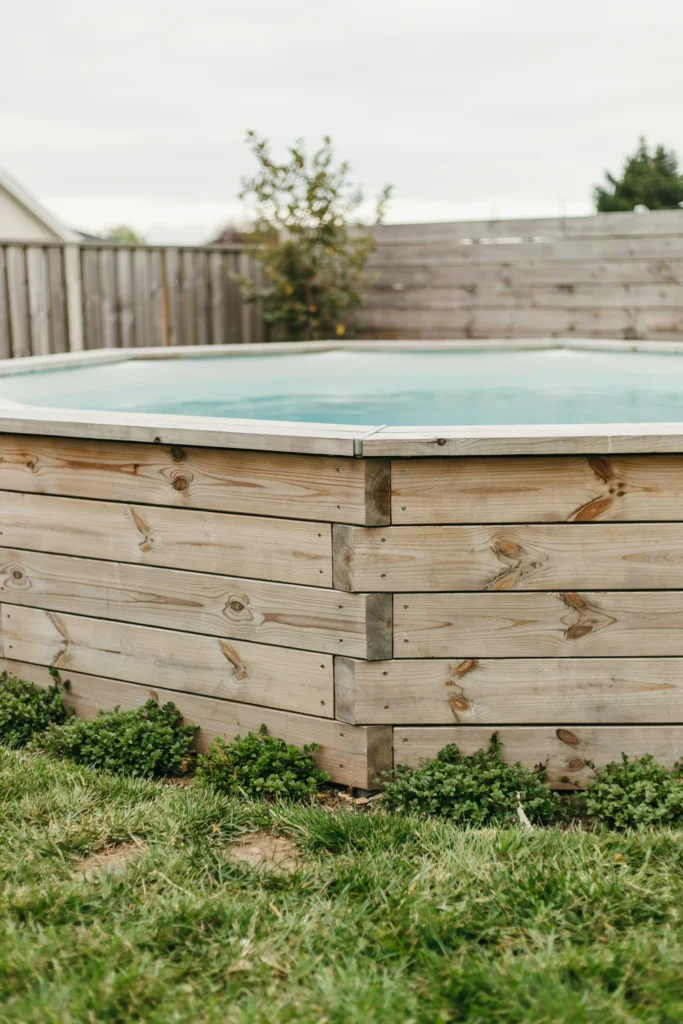
Timber sleepers around the base hide the metal frame and create a tidy edge with the lawn. Two beams high is often enough.
Stagger the joints like brickwork and use galvanized screws. Leave a small gap from the pool wall.
Quick checklist: If you want to hide the frame completely, these above ground pool landscaping ideas help.
- Stagger the joints like brickwork for a stronger, neater finish
- Use galvanized screws so the timber doesn’t rust and stain
- Backfill with soil and plant low ground cover for extra polish
- Hides frame
- Tidy edge
- Gap from wall
4. Raised Timber Platform
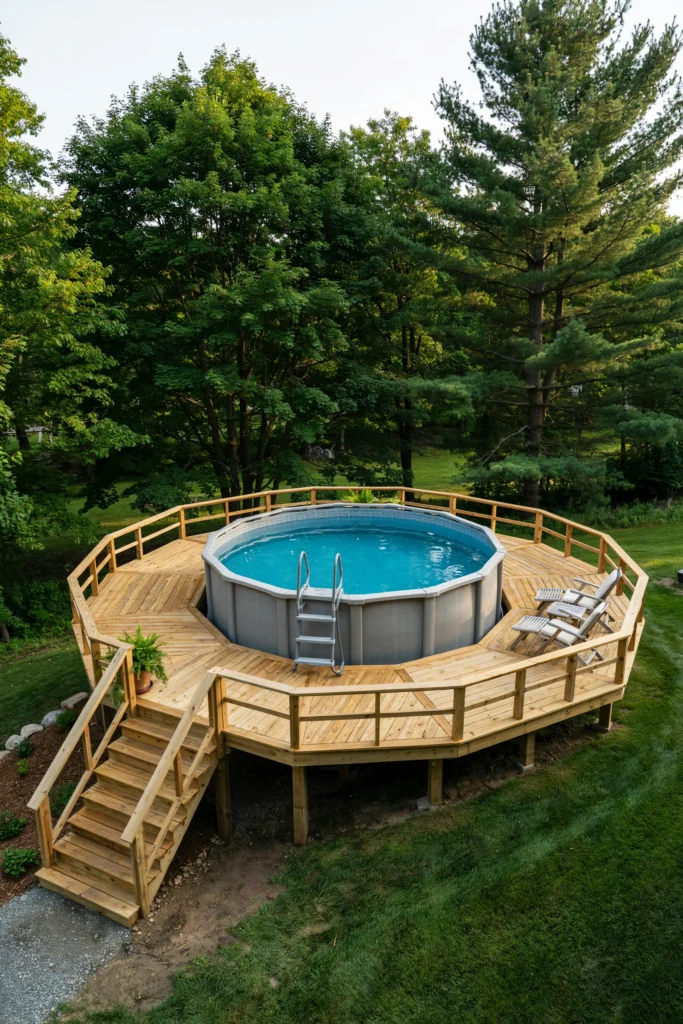
If your yard slopes, a raised platform levels the area and gives you a proper deck. A frame with joists on concrete deck blocks saves digging.
Check local codes before building anything raised, and add railings and stairs with handrails where the drop is high.
Quick checklist:
- Check your local codes before building anything load bearing
- Use concrete deck blocks instead of dug footings to save labor
- Leave a slight gap between boards for drainage
- Fixes slopes
- Proper deck
- Check codes
5. Integrated Patio Extension
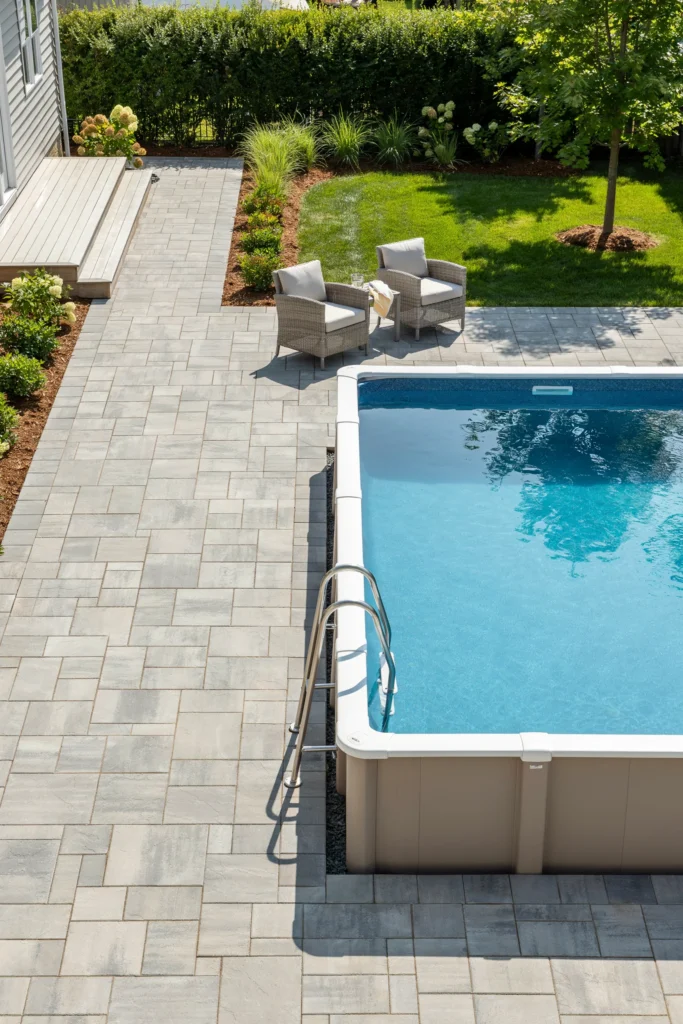
If you already have a patio, extending it to the pool ties the whole backyard together. Even a small extension for two chairs makes the pool look planned.
Use a compacted base and a border edge so pavers stay put.
Quick checklist:
- Match paver color and size to your existing patio where possible
- Use paver sand and a compactor for a stable base
- Add a border edge to keep pavers from shifting over time
- Planned look
- Reuse pavers
- Stable base

6. Gravel or Pea Stone Base
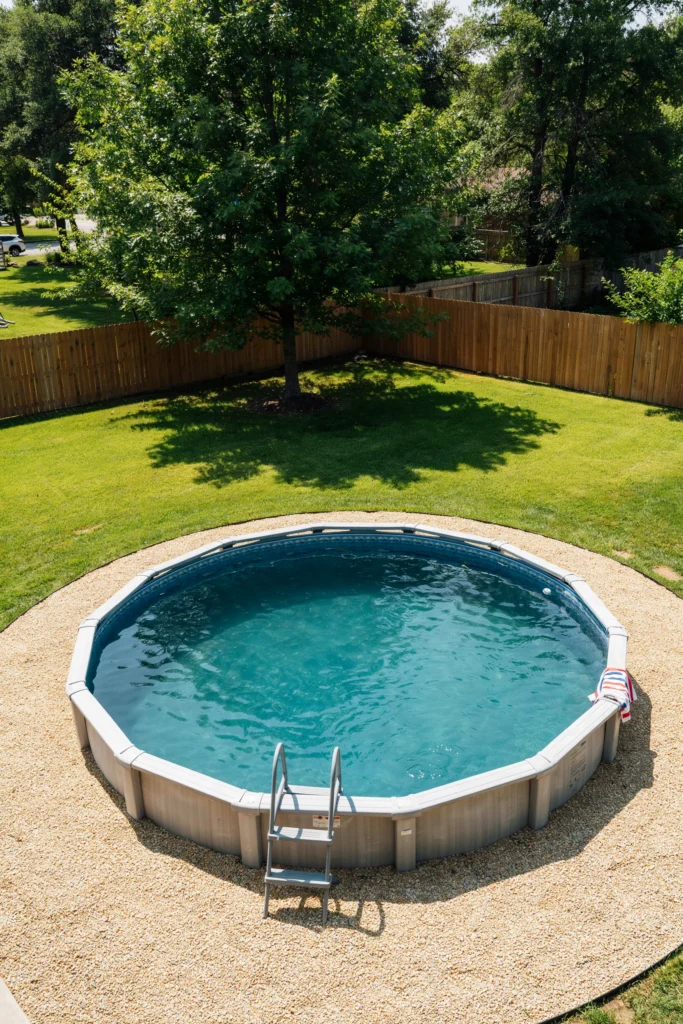
Plain dirt turns to mud fast. Pea gravel is one of the cheapest ground covers and drains well after splash out.
Lay landscape fabric first and use edging to keep the gravel off the lawn.
Quick checklist:
- Lay landscape fabric first to stop weeds from pushing through
- Use edging to keep gravel contained and off the lawn
- Choose a neutral tone like tan or gray to keep it looking clean
- No mud
- Drains well
- Low cost
Project Card · Half a day · Easy
Materials Needed
- Landscape fabric and pins
- Edging strips
- Pea gravel
- Rake and shovel
How to Make It
- Mark a band around the pool about three feet wide.
- Remove grass and level the ground.
- Pin the fabric down and overlap the seams.
- Set edging along the outer line.
- Spread gravel two inches deep and rake smooth.

7. Stacked Stone or Rock Wall
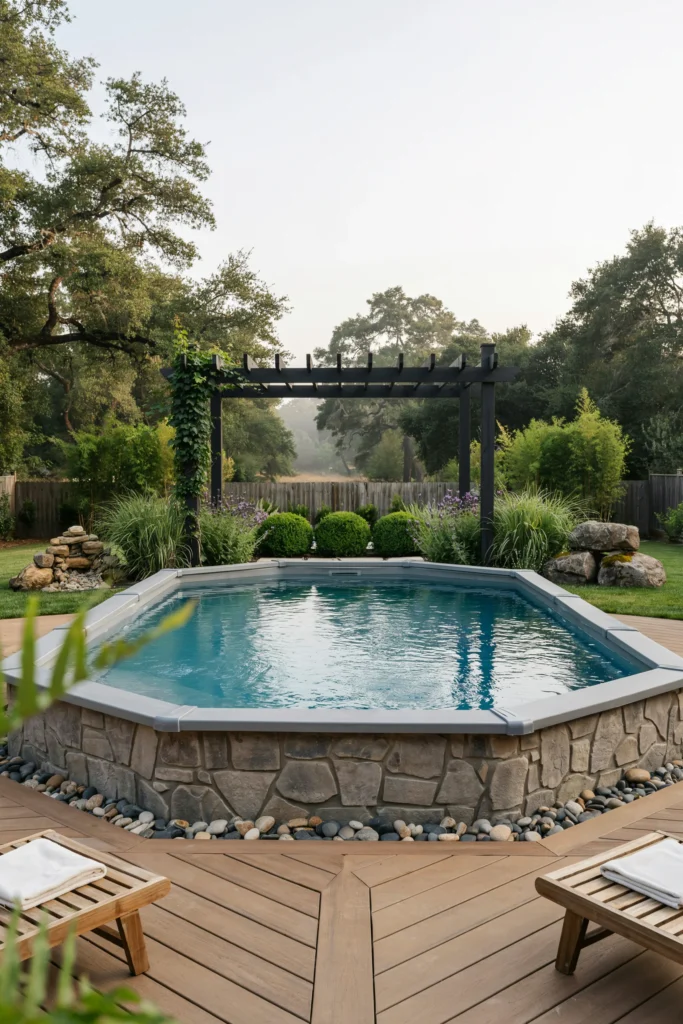
A low stacked stone wall along one side adds texture without the cost of a full stone surround. Focus on the side you see most.
Dry stack block needs no mortar, and a flat cap stone gives a finished top.
Quick checklist:
- Focus stone work on the most visible side of the pool
- Dry stack block needs no mortar, which keeps labor low
- Cap the top row with flat stone for a finished edge
- Texture
- One side only
- No mortar
8. Reed and Bamboo Fencing
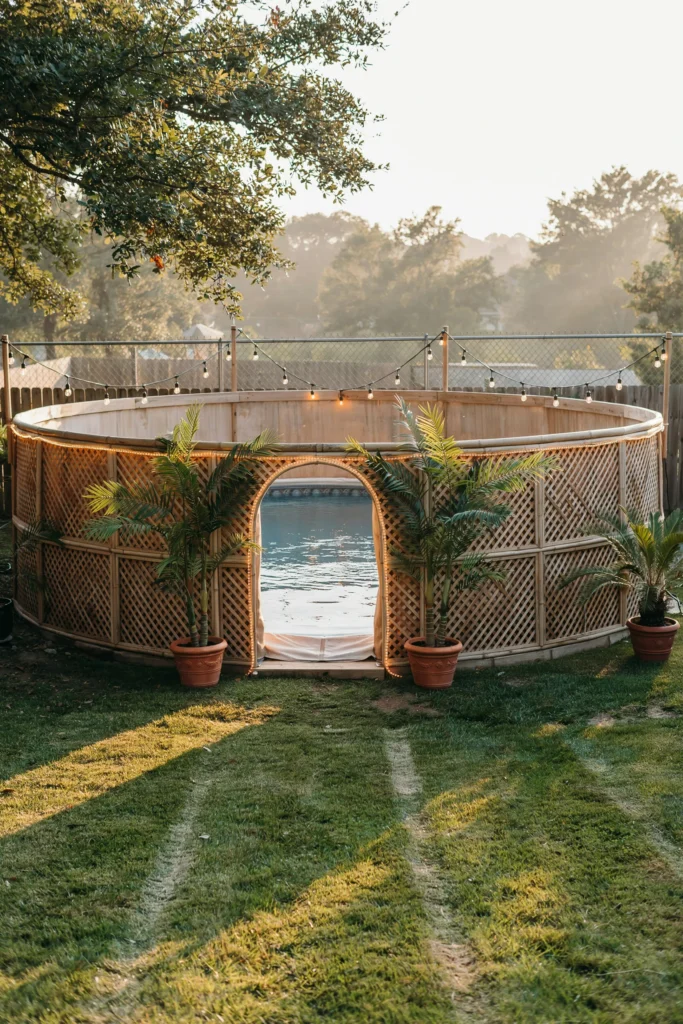
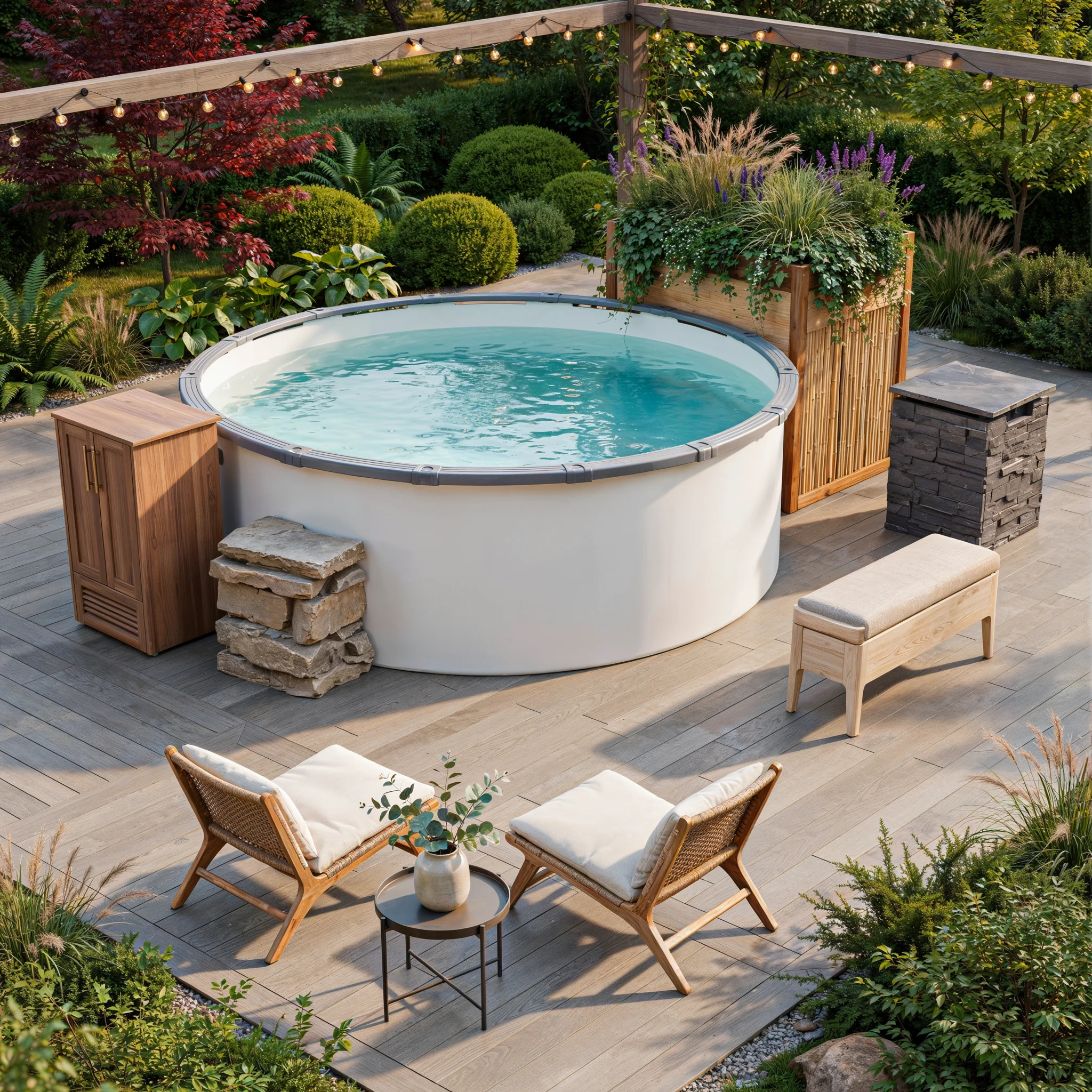
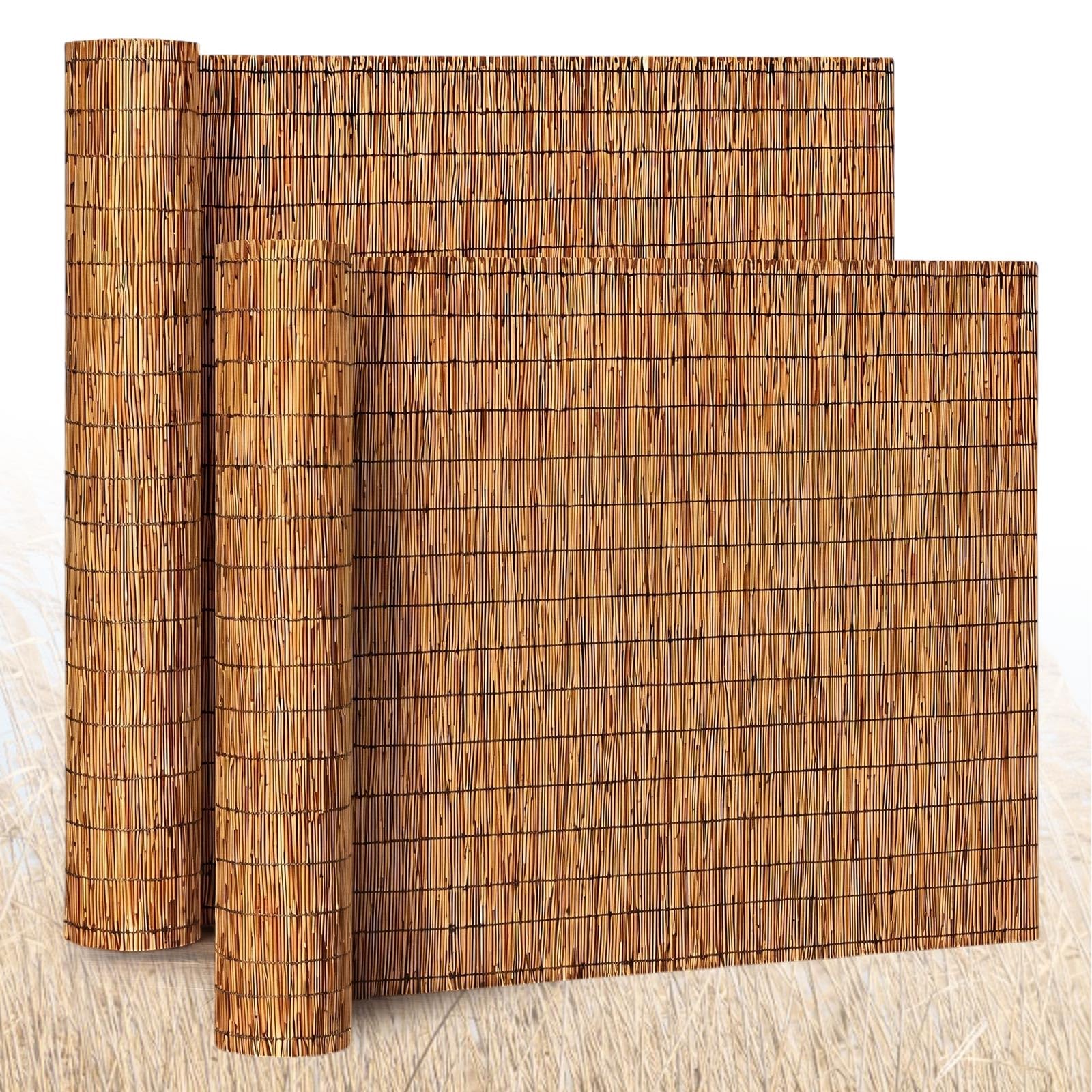
Reed or bamboo screening gives instant resort character. It is sold in rolls and goes up in an afternoon.
Secure it with UV resistant ties so it does not sag. Never use it to cover the required pool barrier in a way that makes it easier to climb.
Quick checklist: For more screening options, see these DIY outdoor privacy screens.
- Buy rolls slightly taller than your fence for a clean top edge
- Secure with UV resistant zip ties so it doesn’t sag in heat
- Combine with string lights for evening swims
- Resort feel
- Quick
- Do not aid climbing
9. Planters and Raised Beds Against the Wall
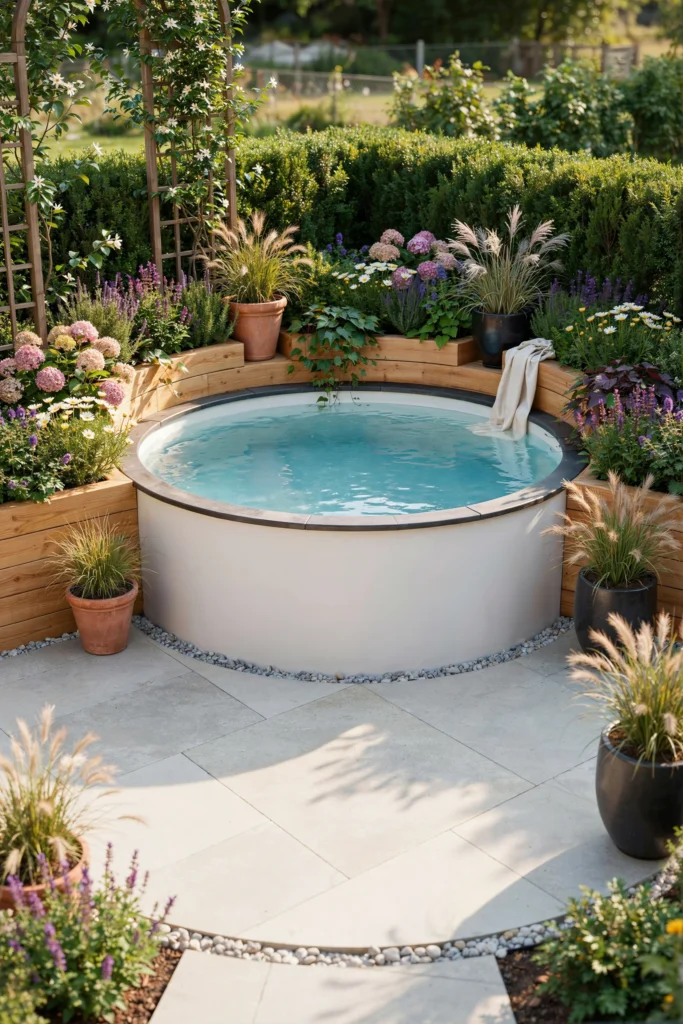
Planters or a narrow raised bed soften the hard edge of the pool. Ornamental grasses and perennials come back every year.
Keep roots away from the liner and choose drought tolerant plants.
Quick checklist:
- Choose drought tolerant plants near the pool to limit watering conflicts
- Keep root systems away from the pool wall and liner
- Mix heights and textures so the bed doesn’t look flat
- Softer edge
- Perennials
- Roots away

10. Slatted Timber Screen
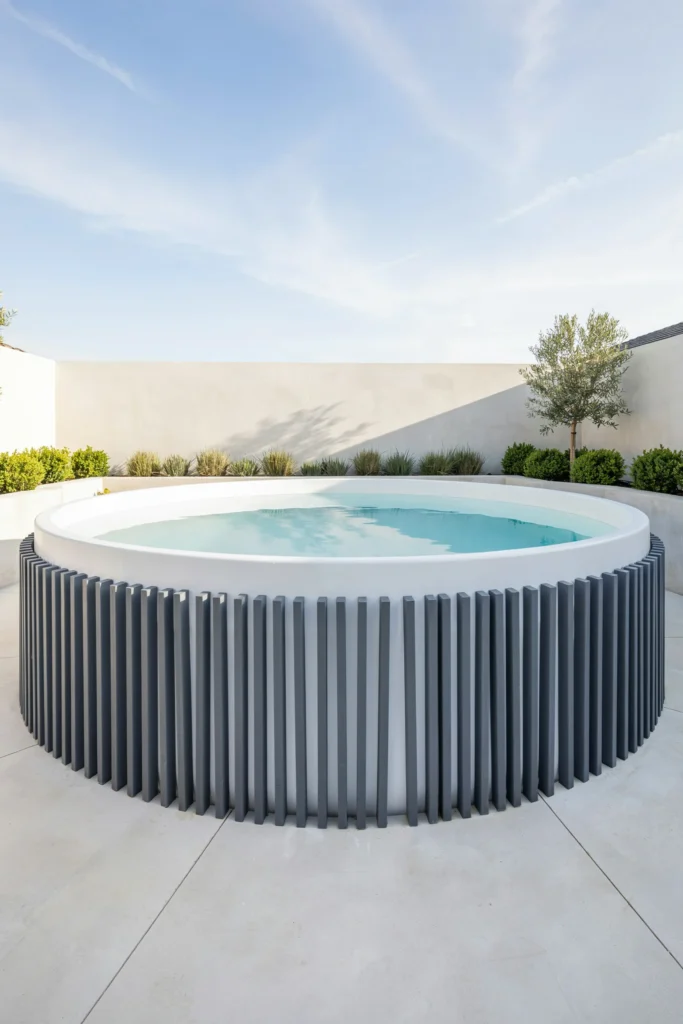
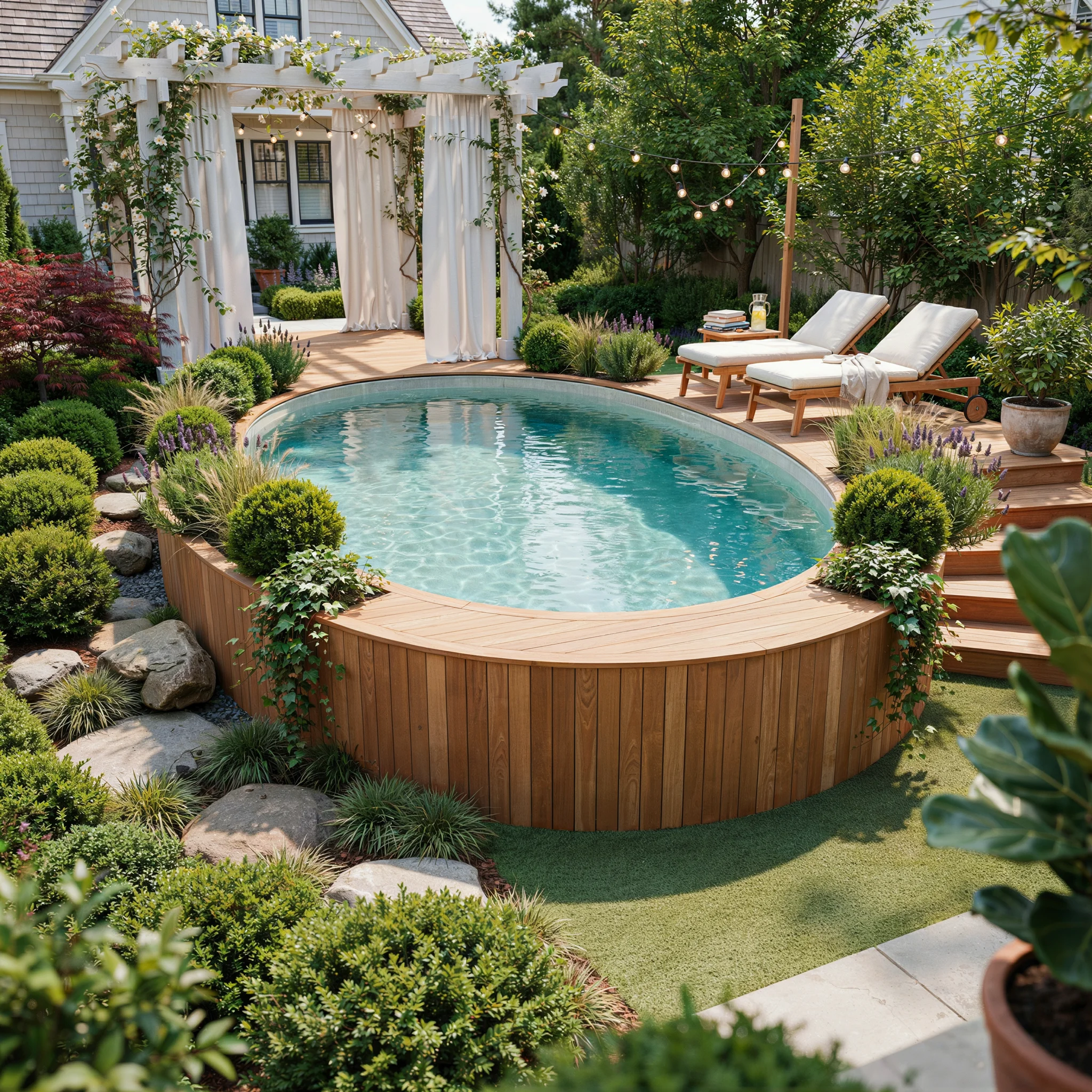
A slatted timber screen works like custom pool skirting. It lets air circulate and the vertical lines look built in.
Furring strips are some of the cheapest lumber you can buy. Attach the screen to its own frame, not the pool.
Quick checklist:
- Space slats with a consistent gap, usually one to two inches
- Prime and paint before installing to save time later
- Attach to a simple frame rather than directly to the pool
- Custom look
- Airflow
- Own frame
Project Card · 1 weekend · Moderate
Materials Needed
- Furring strips or cedar slats
- 2×2 frame boards
- Exterior screws
- Spacer block
- Exterior paint or stain
How to Make It
- Measure the height from ground to the top rail.
- Build a simple rectangular frame for each section.
- Prime and paint the slats before installing.
- Screw slats to the frame using a spacer for even gaps.
- Stand the panels around the pool without screwing into it.
11. Planting Around the Base
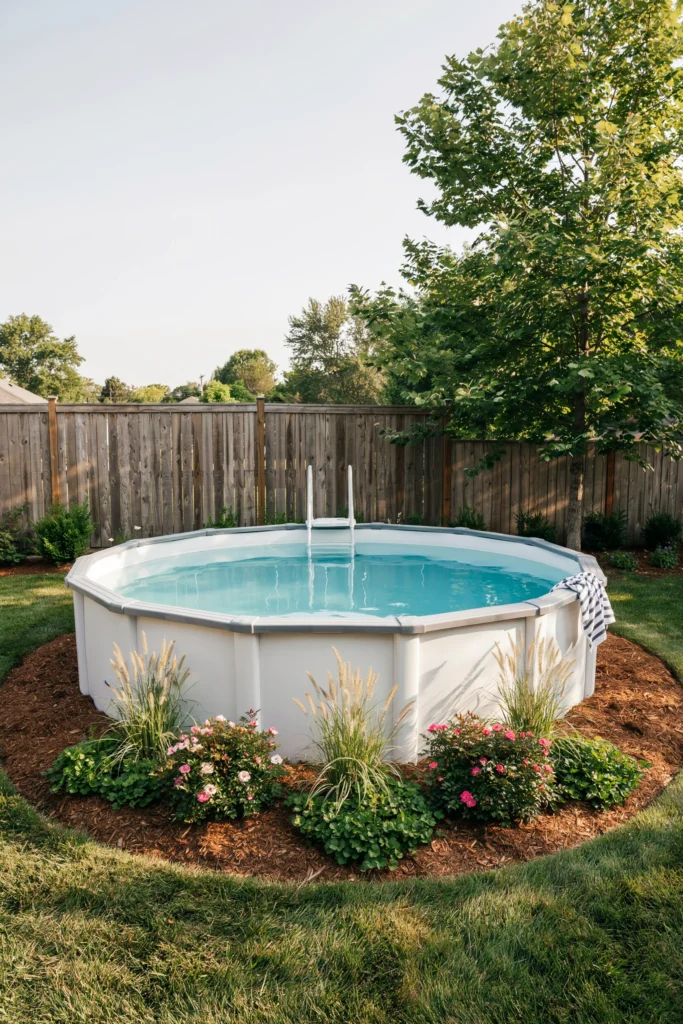
Planting straight into the ground around the base makes a big difference for little money. Small nursery plants fill in within a season.
Group plants in odd numbers and mulch to hold moisture.
Quick checklist:
- Buy small, young plants and give them a season to grow in
- Group plants in odd numbers for a more natural look
- Mulch around new plantings to retain moisture and cut weeding
- Cheapest idea
- Fills in fast
- Odd numbers
12. Mulch Garden Beds Instead of Paving
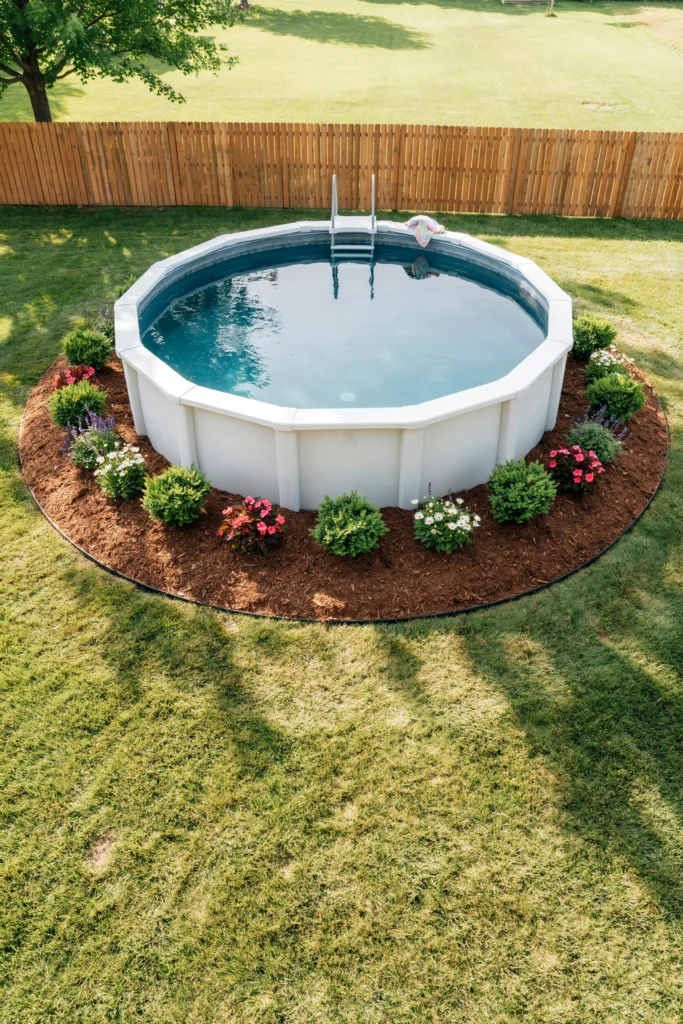
Paving is expensive, mulch is not. Where you do not need a hard surface, mulch beds extend the planted area for much less.
Keep mulch a few inches back from the pool wall and refresh it once a year.
Quick checklist:
- Use shredded hardwood mulch for the best longevity
- Refresh mulch once a year to keep color and coverage consistent
- Keep mulch a few inches back from the pool wall itself
- Low cost
- Feeds soil
- Gap from wall
13. Stepping Stone Path
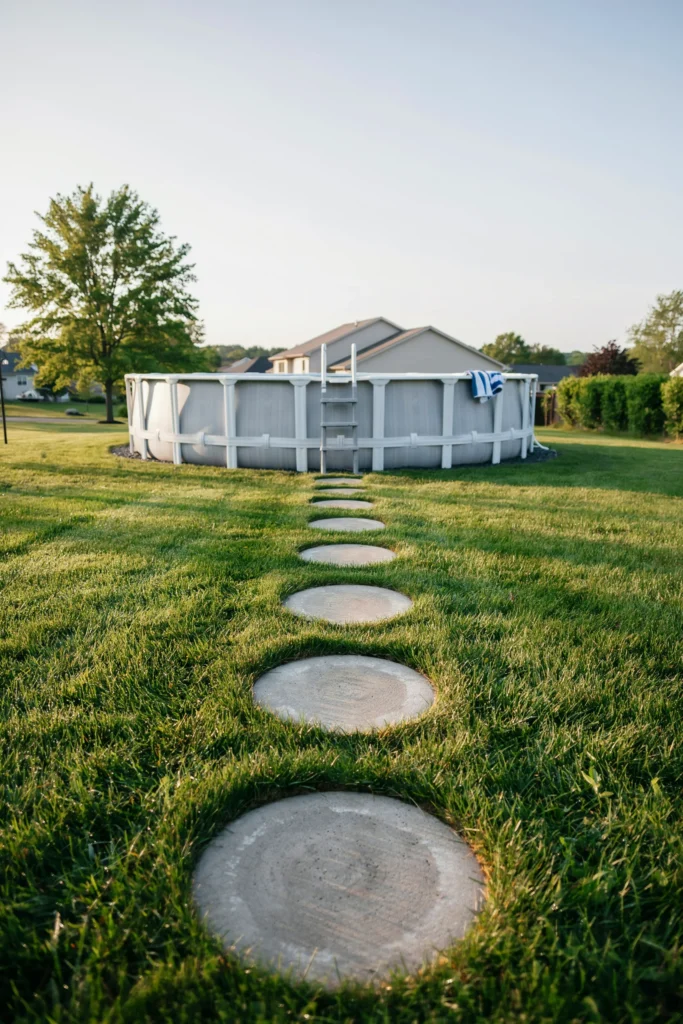
A path of concrete stepping stones from the house to the pool solves muddy feet without a full walkway. It takes one afternoon.
Space stones about a stride apart and set them slightly below the grass so a mower passes over.
Quick checklist:
- Space stones to match a natural walking stride, roughly 24 to 30 inches apart
- Set stones slightly below grade so they don’t catch a mower
- Use sand or gravel underneath each stone for stability
- Clean feet
- One afternoon
- Mower friendly
14. Vertical Planters and Slim Screens
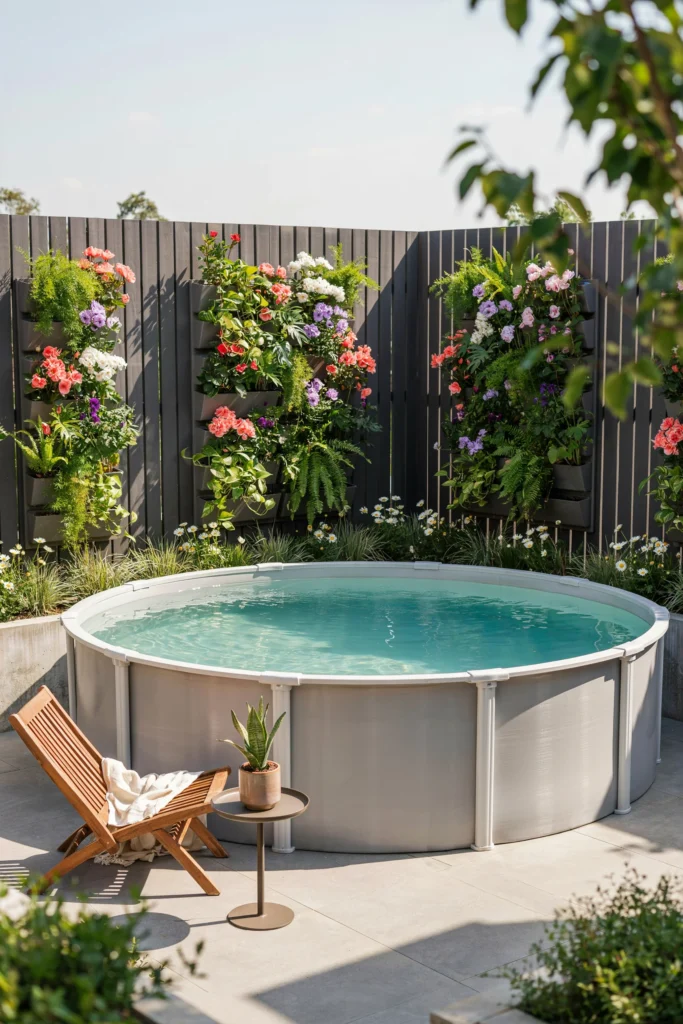
If the pool sits near a fence, vertical planters add greenery without using deck space. Trailing plants fill in fastest.
Mount them at an easy watering height.
Quick checklist:
- Choose a planter system with good drainage to avoid rot on the fence
- Trailing plants like ivy or sweet potato vine fill in fastest
- Mount at a height where watering is easy, not a stretch
- Saves space
- Green
- Easy watering
15. Outdoor Rug and Bistro Set on the Deck
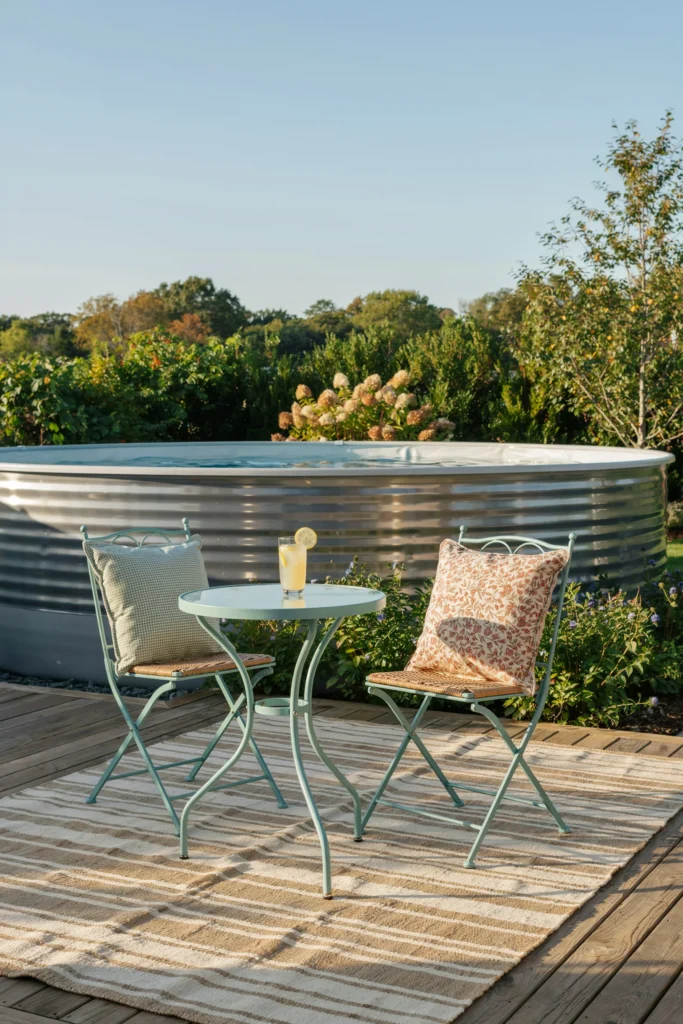
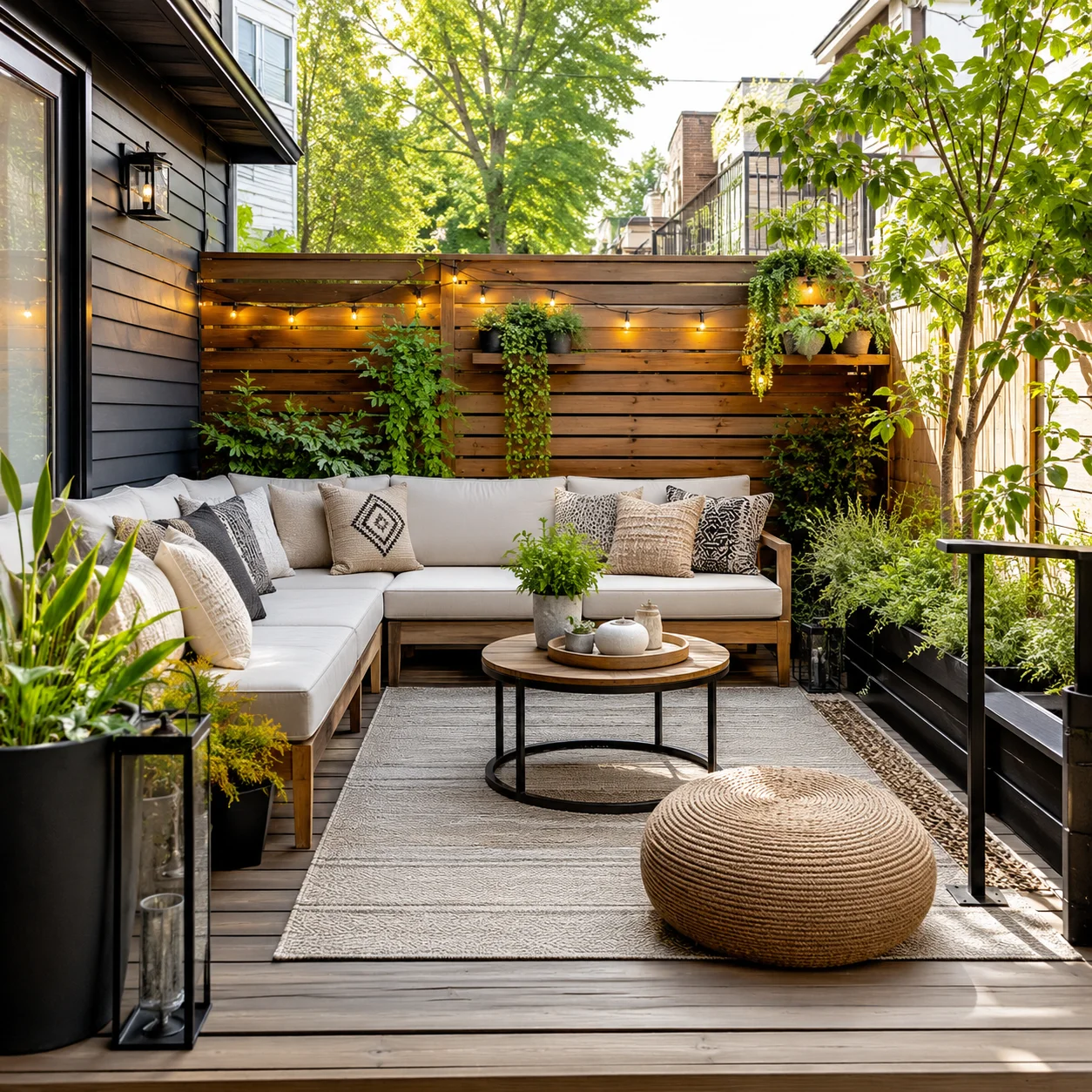
Furniture changes how a space feels. An outdoor rug and a small bistro set turn a pool entry into a place to relax.
Secondhand pieces often just need paint and new cushions.
Quick checklist:
- Choose a rug rated for outdoor or high moisture use
- A bistro set takes up less space than full patio furniture
- Secondhand furniture often just needs paint and new cushions
- Relax spot
- Secondhand
- Small footprint

16. String Lights and Woven Textiles
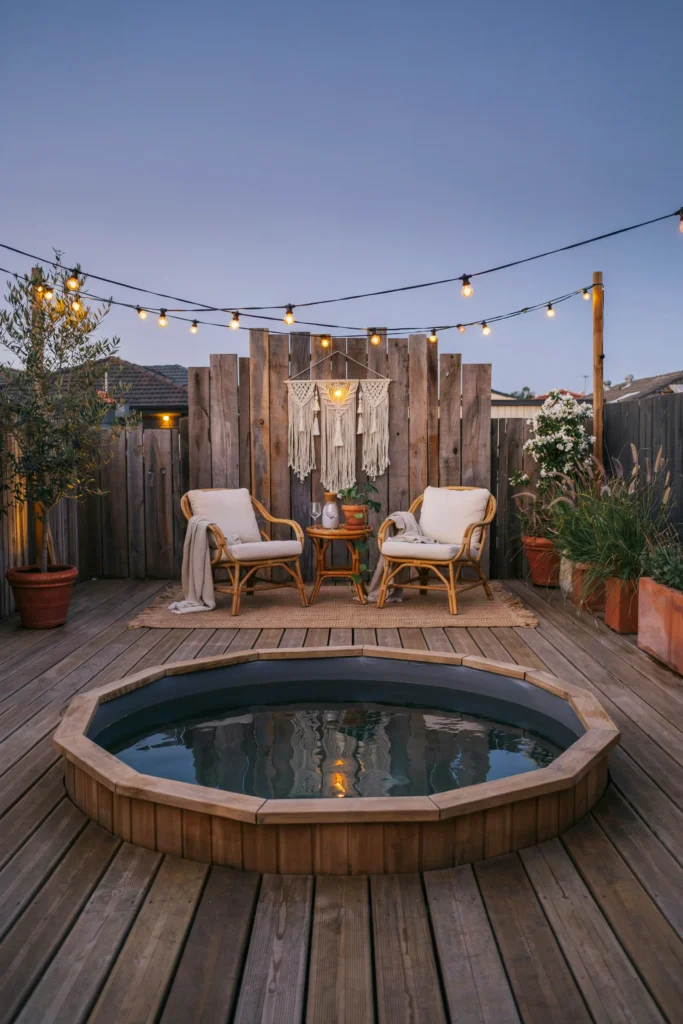
String lights above the deck make the pool area feel designed for evenings. Add a woven outdoor rug and a macrame hanging near the seating.
Solar powered lights avoid extension cords near water. Bring textiles in during heavy rain.
Quick checklist: You will find more glow ideas in these above ground pool lighting ideas.
- Use solar powered string lights to avoid running extension cords
- Bring macramé and textiles in during heavy rain to extend their life
- Layer textures, woven, knotted, smooth, for visual interest
- Evening feel
- Solar near water
- Texture
Project Card · 1 hour · Easy
Materials Needed
- Solar string lights
- Light hooks or deck posts
- Woven outdoor rug
- Zip ties
How to Make It
- Place the solar panel where it gets afternoon sun.
- Screw hooks into deck posts or a fence.
- Drape the lights with a gentle sag between hooks.
- Secure the cable with zip ties.
- Lay the rug on the deck under the seating.
17. Built In Bench Along the Deck
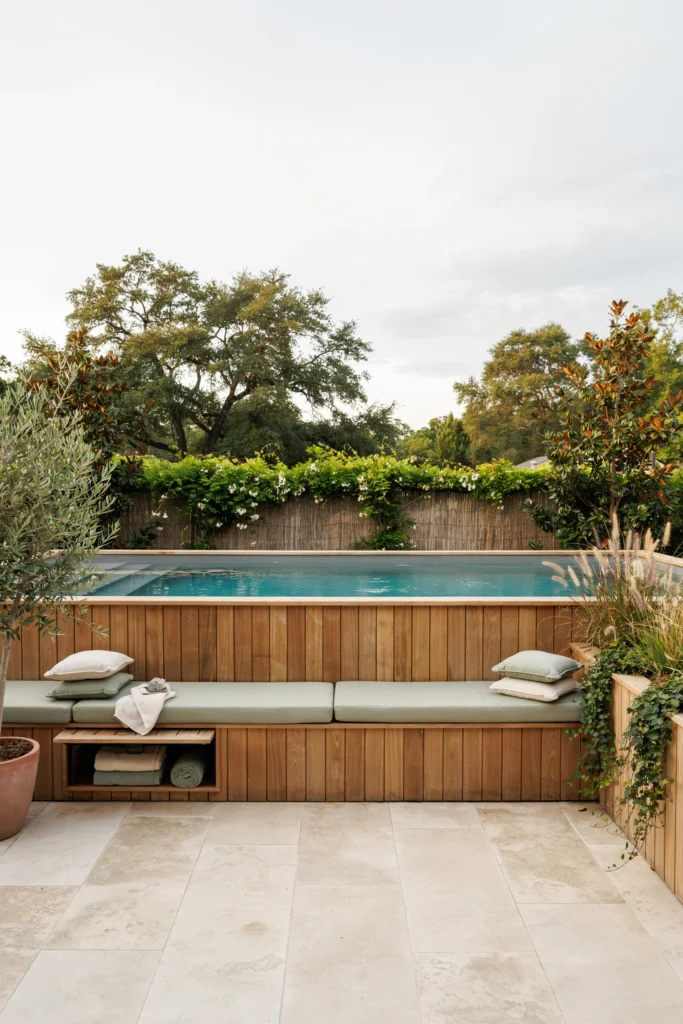
A built in bench along the deck edge gives seating without buying furniture. Use the same boards as the deck so it blends in.
Build it at 16 to 18 inches high and add weatherproof cushions. Keep benches away from the pool wall so children cannot use them to climb in.
Quick checklist:
- Build the bench at a standard seat height of 16 to 18 inches
- Use the same decking material so the bench blends in, not stands out
- Add weatherproof cushions for comfort during long pool days
- Free seating
- Matches deck
- Not a climbing step

18. Painted Exterior or Mural
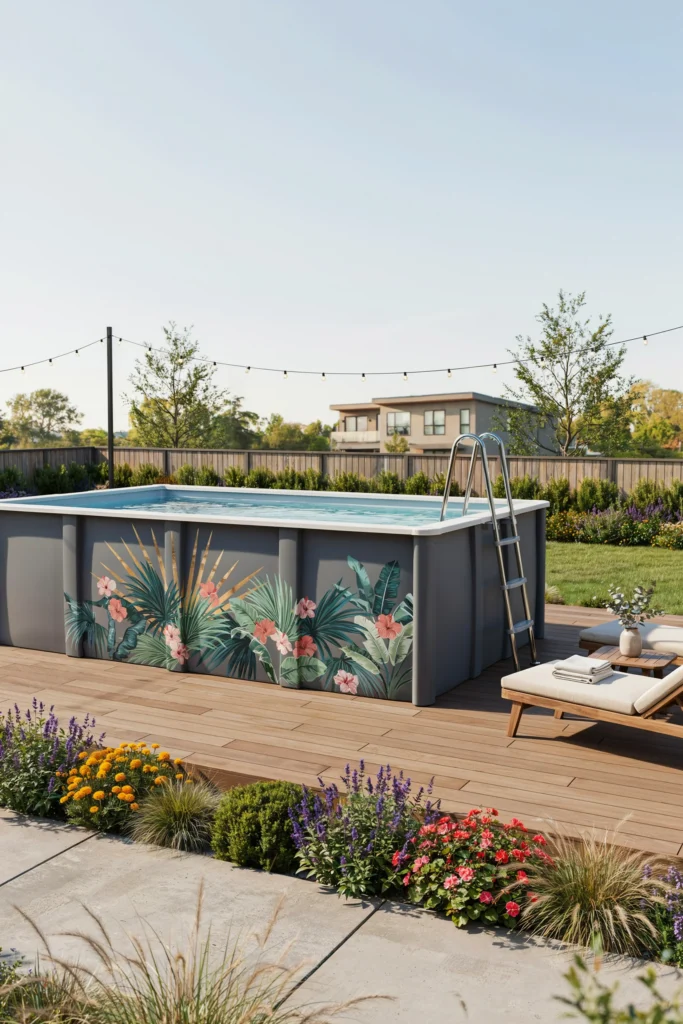
Many pools come in a plain finish. Exterior paint in a color that matches your house makes a huge difference.
A simple band or wave pattern looks intentional. Use paint rated for your pool material and check the warranty first.
Quick checklist:
- Use paint rated for metal or exterior siding, depending on your pool material
- Test colors against your fence and house before committing
- Keep patterns simple, a band of color or basic stripe reads as intentional
- Custom color
- Simple pattern
- Check warranty
19. Corner Placement and Build Around Design
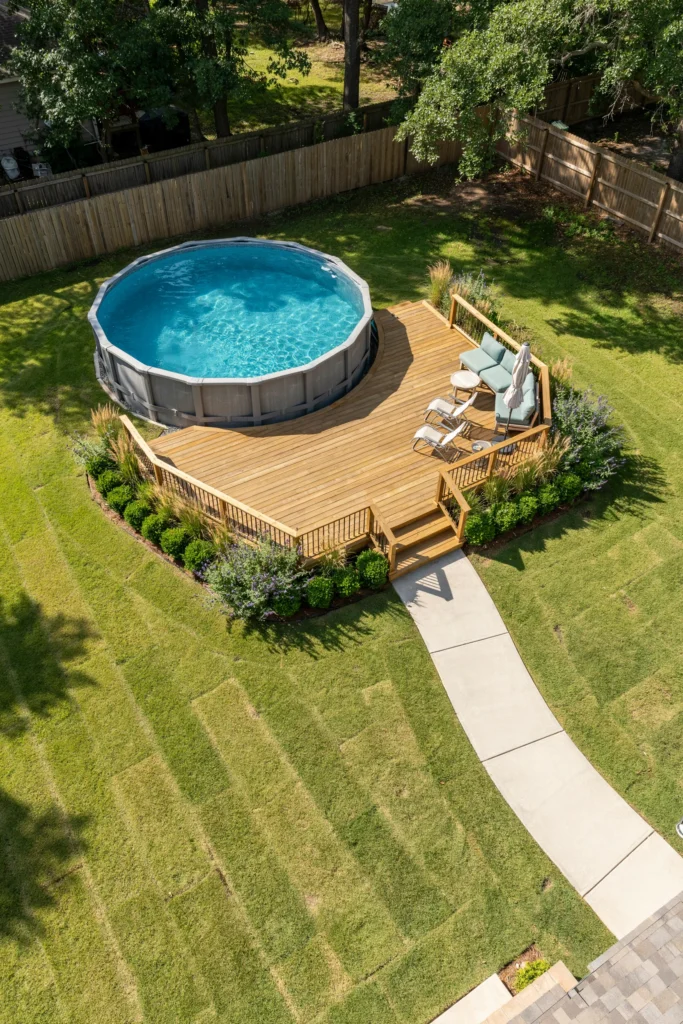
Placement matters as much as decor. Tucking the pool into a corner leaves room to build a deck or planting bed on the open sides.
Leave about three feet from fences for maintenance access.
Quick checklist:
- Plan placement before installation if you still have the choice
- Leave at least three feet of clearance from fences for maintenance access
- Use the open sides for deck, seating, or planting, not just lawn
- Plan first
- Open sides
- Service access
20. Matching Hardscape to the Pool Border
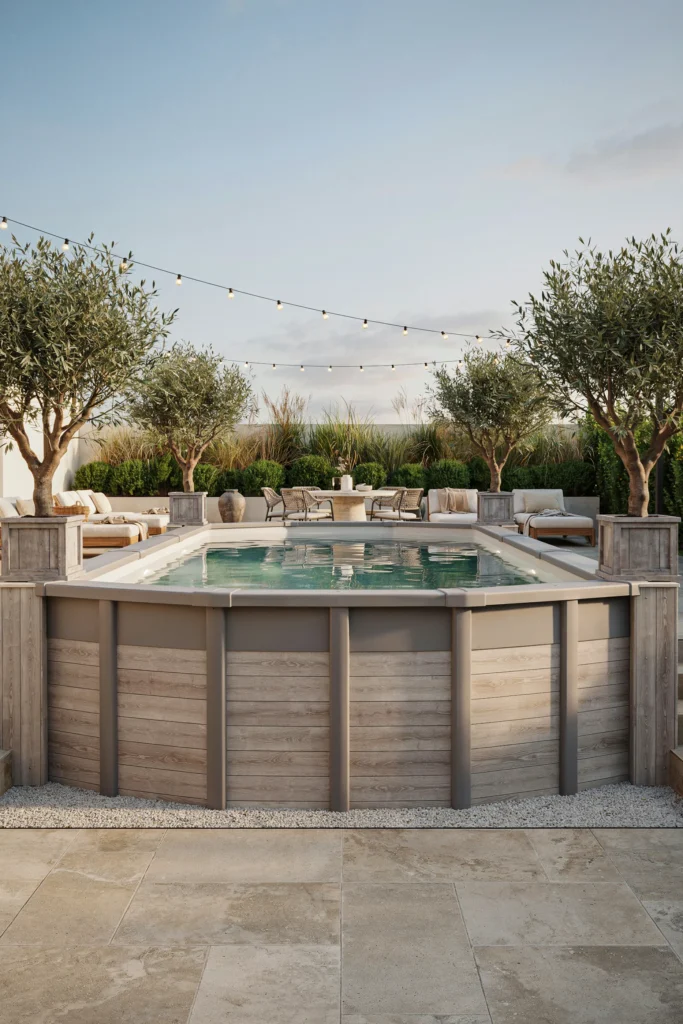
The fastest way to make a budget setup look pulled together is consistency. Pick one material family, like warm wood and gray stone, and use it everywhere.
Match screws and fixtures where visible and keep colors in the same warm or cool family. An exterior wood stain in one shade ties the deck, bench, and screen together.
Quick checklist:
- Pick two to three materials total and repeat them throughout the space
- Match hardware finishes, like screws and fixtures, where visible
- Keep color palettes within the same warm or cool family
- Pulled together
- Two or three materials
- One stain color
Cost Saving Tips That Actually Help
A few habits keep spending down without cutting corners. Shop end of season sales for lumber, paint, and outdoor textiles.
Check local marketplace groups for free pallets and leftover pavers, tackle one upgrade at a time, and reuse leftover deck boards for benches.
Design Style Match Ups
Not every idea on this list fits every yard. Here’s how to match the upgrades above to a style you already love.
- Coastal or beachy: reed fencing, pea gravel, woven textiles, light wood tones
- Modern minimalist: slatted timber screens, gray stone, simple paint, clean lines
- Cottage or garden style: raised planting beds, mulch borders, stepping stone paths
- Rustic or farmhouse: pallet decking, stacked stone walls, reclaimed timber edging
Small Yard & Space Saving Strategies
A smaller yard doesn’t rule out any of these ideas, it just means choosing them carefully. These adjustments helped us make the most of a tight space.
- Use vertical planters instead of ground beds to save floor space
- Build a partial deck rather than a full wraparound to leave room to move
- Choose a bistro set over full patio furniture so seating doesn’t crowd the area
- Tuck the pool into a corner so the rest of the yard stays open and usable
- Stick to one or two upgrades that do the most visual work, like lighting and a clean border
Frequently Asked Questions
What is the cheapest way to make an above ground pool look nice?
Gravel, planting around the base, string lights, and paint are some of the lowest cost upgrades.
Are pallet decks safe around a pool?
Only with heat treated pallets stamped HT, sanded smooth, sealed, and checked each season for loose boards.
Do I need a permit for an above ground pool deck?
Many areas require one for raised decks. Check your local code before building.
How do I keep children safe around an above ground pool?
Use removable or lockable steps, a fence or barrier with a self latching gate, and never leave children unsupervised.
How can I hide the pool frame on a budget?
Timber sleepers, reed fencing, slatted screens, and planting around the base all hide the frame for little money.
Final Thoughts on Stunning Above Ground Pool Ideas on a Budget
None of these upgrades need a big budget or a professional crew. We worked through them one weekend at a time, and the pool area slowly became a place we wanted to spend every evening.
Pick two or three ideas that suit your yard and budget, and build from there. The rest can wait until next season. Want the pool to look built in? See this guide on how to make an above ground pool look inground.